

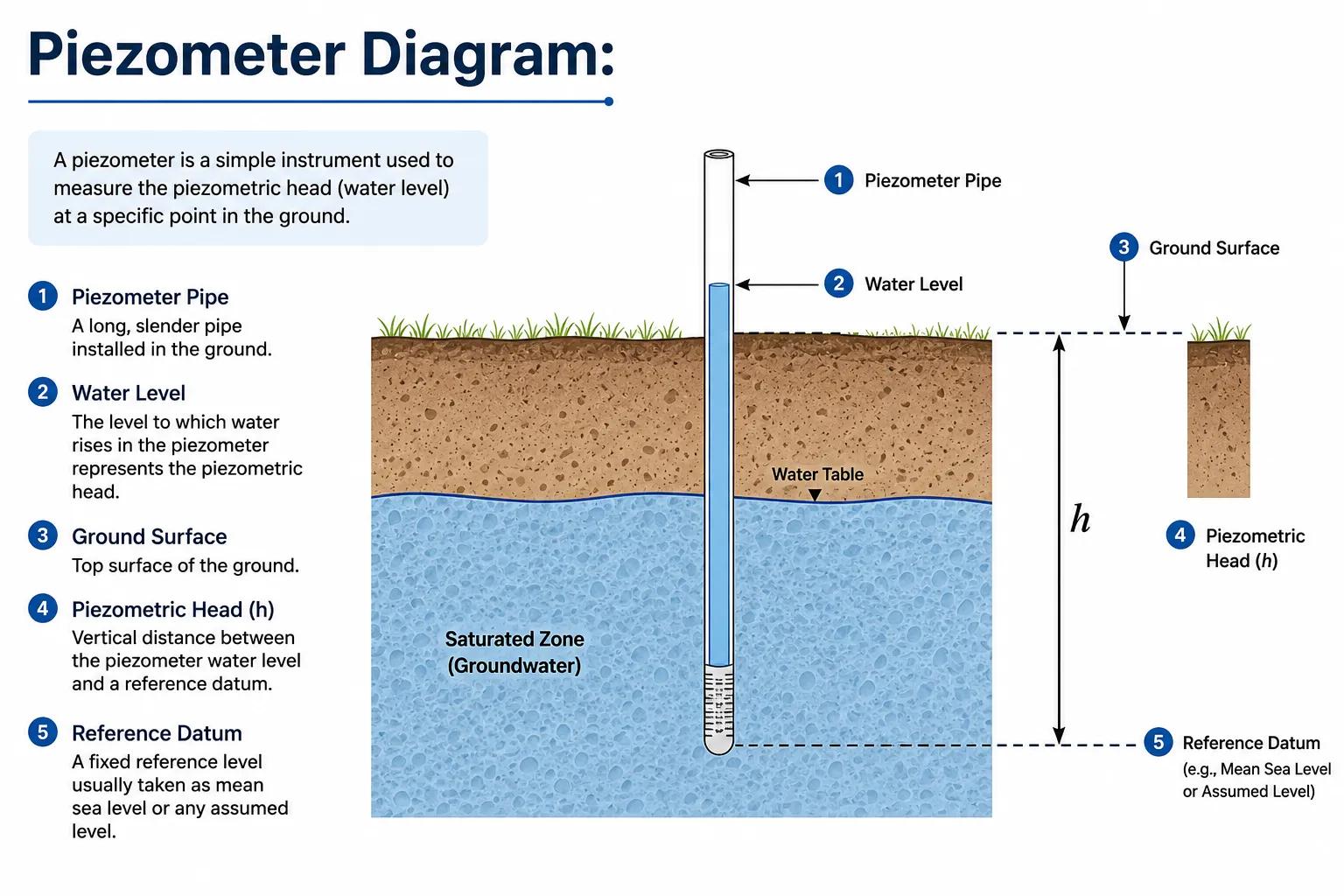
Reliable groundwater data is the backbone of every successful infrastructure, mining, and environmental project. Without it, engineers and project managers operate in the dark — risking costly failures, regulatory non-compliance, and environmental damage. A piezometer diagram is the first step toward understanding what lies beneath the surface.
A piezometer is a precision instrument designed to measure groundwater pressure and water table levels in boreholes, observation wells, and subsurface formations. The piezometer installation diagram illustrates how each component — casing, filter tip, sensor, and data logger — connects to deliver continuous, accurate readings. At Bhoojal Survey, we deploy these systems across industrial, mining, irrigation, and government groundwater management projects throughout India.
What is a Piezometer Diagram?
A piezometer diagram is a schematic representation of the complete groundwater monitoring piezometer assembly — from surface casing to the sensing element installed at depth. It shows the spatial arrangement of all structural and electronic components, making it an essential reference for field installation teams, hydrogeologists, and compliance engineers.
Key components typically shown in a piezometer construction diagram:
- Outer casing / borehole lining — protects the instrument from surrounding soil pressure
- Filter tip / porous stone — allows pore water to enter the sensor zone
- Pressure transducer or vibrating wire element — converts water pressure to a measurable signal
- Grout seal and bentonite seal — prevents surface water from contaminating readings
- Signal cable and data logger — transmits and stores real-time groundwater data
- Surface protection cap — secures the installation from tampering and weather
Understanding the piezometer working diagram enables engineers to select the correct installation depth, interpret readings accurately, and ensure long-term reliability of the groundwater observation well.
Why Piezometer Monitoring is Important
Groundwater is a dynamic resource. Water table levels shift with seasonal recharge, extraction activities, and land-use changes. A professional groundwater monitoring piezometer system captures these changes in real time, supporting critical decisions across several domains:
- Environmental compliance — meeting CGWB and state pollution control board requirements
- Dam and embankment safety — detecting dangerous pore pressure build-up behind structures
- Subsidence monitoring — identifying ground settlement risks in construction zones
- Mine dewatering management — controlling groundwater inflow into open-pit and underground workings
- Irrigation and agriculture — tracking seasonal aquifer depletion for sustainable water use
- Infrastructure protection — safeguarding foundations of bridges, tunnels, and high-rise structures
Without a properly installed groundwater pressure monitoring system, projects face unpredictable risks that can result in structural failure, regulatory penalties, and irreversible environmental damage.
Types of Piezometer Systems
Selecting the right piezometer instrumentation depends on project depth, required accuracy, monitoring duration, and data transmission needs. Bhoojal Survey works with all major piezometer types:
Standpipe Piezometer
The simplest and most cost-effective design. A perforated standpipe is installed in a borehole; water level is measured manually using an electrical dipper. Ideal for long-term, low-frequency groundwater observation well monitoring.
Vibrating Wire Piezometer
A high-precision sensor that converts water pressure into a vibrating wire frequency signal. Highly stable over long periods and suitable for remote data logging in dams, tunnels, and deep aquifer monitoring.
Pneumatic Piezometer
Uses nitrogen gas pressure to balance pore water pressure. Well-suited for hazardous environments where electrical sensors are not safe, such as landfill leachate monitoring.
Digital Piezometer System
Integrates pressure transducers with IoT-enabled data loggers for real-time remote monitoring. The digital piezometer monitoring solution provides automated alerts, cloud data storage, and instant reporting — critical for large infrastructure projects.
Automatic Water Level Monitoring Instruments
These systems use submersible pressure sensors combined with SCADA or telemetry networks for continuous, unattended groundwater level monitoring across multiple boreholes simultaneously.
Our field teams are experienced in conducting hydrogeological surveys using SSRMPATS Instrument, GER DETECT, and PQWT at site for open well / borewell location — delivering advanced groundwater and hydrogeological monitoring solutions with scientific groundwater observation and pressure analysis.
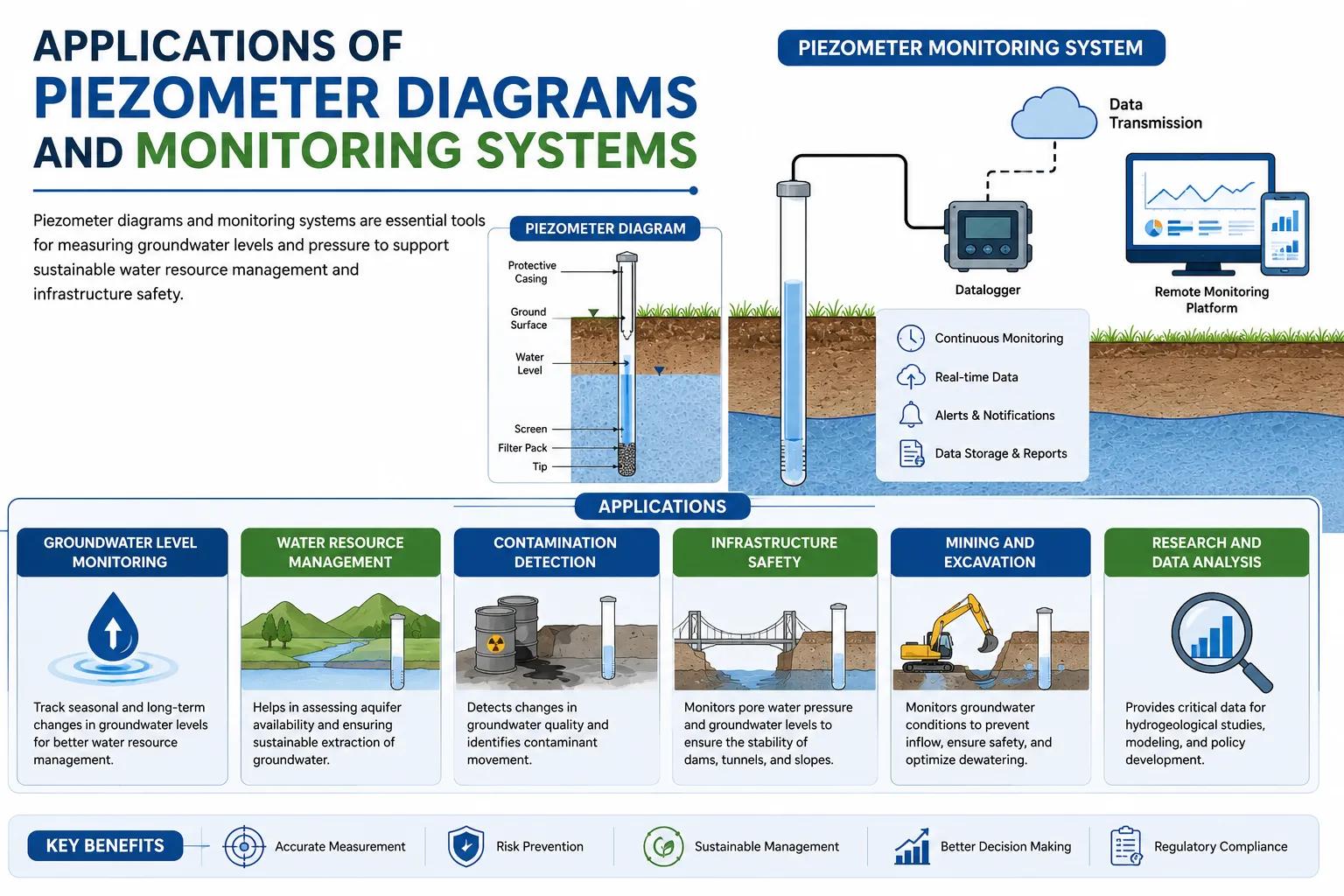
Applications of Piezometer Diagrams and Monitoring Systems
A well-executed hydrogeological piezometer survey supports a wide range of project types across India's growing infrastructure landscape:
Groundwater Observation Wells
Establishing baseline water table data for CGWA compliance, environmental impact assessments, and long-term aquifer management.
Mining and Excavation Projects
Real-time pore pressure monitoring in open-cast and underground mines prevents slope failures and controls dewatering operations.
Dam and Embankment Monitoring
Vibrating wire piezometers embedded in earth dams detect seepage and pore pressure anomalies before they become structural threats.
Infrastructure and Tunnel Projects
Monitoring groundwater pressure around tunnels, metro rail corridors, and deep foundations ensures structural integrity during and after construction.
Irrigation and Agriculture
Seasonal aquifer monitoring helps irrigation departments and farmers manage sustainable groundwater extraction.
Environmental Compliance Projects
Industries near sensitive water bodies require continuous piezometric level analysis to demonstrate zero groundwater contamination.
Why Choose Bhoojal Survey for Piezometer Services?
Bhoojal Survey is a professional groundwater monitoring consultancy with deep expertise in piezometer installation services, hydrogeological investigation, and environmental groundwater monitoring across India. Here is why project owners and engineers trust us:
- Experienced hydrogeologists with 15+ years in piezometer monitoring and groundwater investigation
- Advanced digital piezometer monitoring solutions including vibrating wire, standpipe, and IoT-enabled systems
- Accurate piezometric data analysis with detailed technical reports for compliance and project design
- Fast mobilisation — our field teams are available across all major states in India
- Customised monitoring solutions tailored to mining, infrastructure, irrigation, and industrial projects
- CGWB and regulatory compliance support for CGWA NOC applications and state-level permits
- Pan-India coverage for groundwater observation well services and hydrogeological monitoring consultancy
Conclusion
A piezometer diagram is far more than a technical drawing — it is the foundation of every reliable groundwater monitoring system. Whether you are managing a mining operation, constructing critical infrastructure, or ensuring environmental compliance, professionally installed and well-maintained piezometers give you the accurate subsurface water pressure data you need to make informed decisions.
Bhoojal Survey combines field expertise, advanced instrumentation, and scientific methodology to deliver groundwater monitoring solutions that stand up to regulatory scrutiny and real-world project demands.
Frequently Asked Questions (FAQ)
Q1. What is a piezometer diagram?
A piezometer diagram is a schematic showing the complete assembly of a groundwater monitoring piezometer — including the borehole casing, filter tip, pressure sensor, seals, and data logger — used as a reference for installation and operation.
Q2. How does a piezometer work?
A piezometer works by placing a pressure-sensitive element (transducer or vibrating wire) at a specific depth in a borehole. The surrounding pore water pressure acts on the sensor, which converts the pressure into an electrical or frequency signal transmitted to a surface data logger for recording.
Q3. What is a piezometer used for?
Piezometers are used for measuring groundwater levels, monitoring pore water pressure in dams and embankments, tracking aquifer depletion, supporting environmental compliance, and ensuring the safety of infrastructure built near or below the water table.
Q4. What are the main types of piezometers?
The main types include standpipe (open) piezometers, vibrating wire piezometers, pneumatic piezometers, and digital/electronic piezometer systems with automated data loggers. Each type is selected based on project depth, required accuracy, and data transmission needs.
Q5. Why is groundwater monitoring important for infrastructure projects?
Groundwater monitoring is critical because fluctuating water table levels and pore pressures can cause foundation failure, slope instability, and structural damage. Continuous piezometer data allows engineers to detect problems early and take corrective action before costly failures occur.
Q6. What is the difference between a standpipe and a vibrating wire piezometer?
A standpipe piezometer is a simple open tube where water level is measured manually with a dipper — low cost and easy to maintain. A vibrating wire piezometer uses an electronic sensor for automated, high-precision readings suitable for remote monitoring and data logging in real time.
Q7. Does Bhoojal Survey provide piezometer installation services across India?
Yes. Bhoojal Survey offers professional piezometer installation, groundwater monitoring, and hydrogeological investigation services across all major states in India, covering industrial, mining, infrastructure, irrigation, and government projects.
Q8. What authority references are relevant for piezometer and groundwater compliance in India?
Key authorities include the Central Ground Water Board (CGWB), Ministry of Jal Shakti, and the Geological Survey of India (GSI). CGWA (Central Ground Water Authority) NOC compliance is mandatory for groundwater extraction in notified areas.