

Introduction
A piezometer is used to measure groundwater pressure, pore water pressure, and subsurface water table levels with high accuracy. In geotechnical and hydrogeological engineering, understanding subsurface water behaviour is fundamental to the safety of dams, slopes, tunnels, foundations, and mining structures. Piezometers provide the critical real-time data that engineers need to make informed decisions before, during, and after construction.
Whether deployed in a large dam safety instrumentation programme, a railway embankment investigation, or a groundwater monitoring well network, piezometers remain one of the most essential geotechnical instruments in the field. At Bhoojal Survey, our team of experienced hydrogeologists and geotechnical engineers has installed and monitored piezometer networks across hundreds of projects throughout India — delivering reliable data and actionable engineering insights.
Quick Answer: A piezometer measures groundwater pressure (hydraulic head), pore water pressure, seepage pressure, and water table levels in soil, rock, and fill materials.
What is a Piezometer?
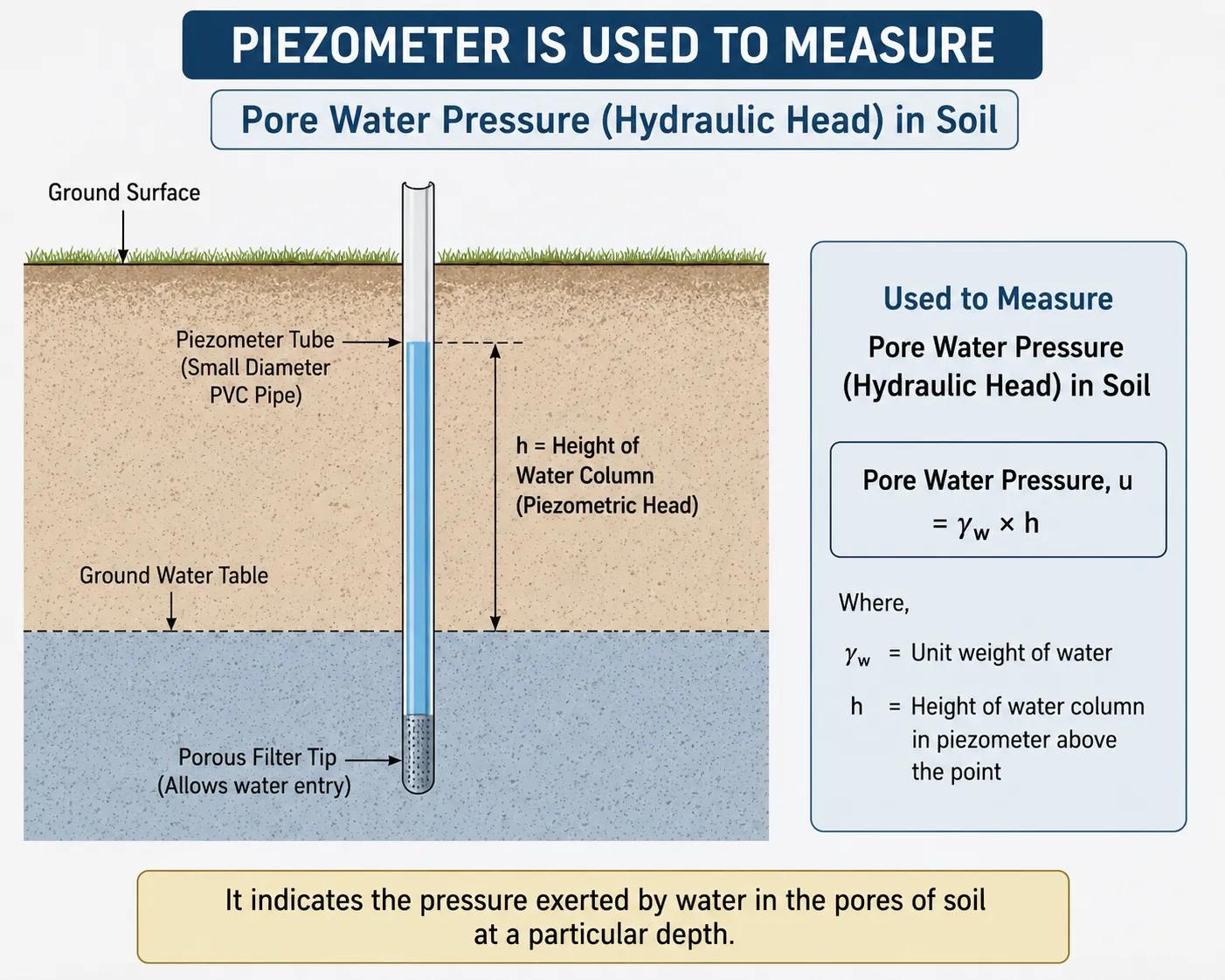
A piezometer is a scientific instrument installed within a borehole or embankment to measure fluid pressure at a specific point in the subsurface. The term is derived from the Greek word piezein, meaning "to press." By measuring the pressure of groundwater at a given depth, engineers can determine the hydraulic head, assess groundwater flow directions, and evaluate soil stability conditions.
Piezometers are used across geotechnical engineering, hydrogeological investigations, dam safety monitoring, mining, and infrastructure development. They come in several types — standpipe, vibrating wire, and pneumatic — each suited to specific site conditions and monitoring requirements.
Piezometer is Used to Measure — Detailed Explanation
The primary parameters that a piezometer is used to measure include:
- Groundwater Pressure: The pressure exerted by groundwater at a particular depth below the surface, expressed as a head of water (metres) or in kPa/psi.
- Pore Water Pressure: The pressure of water within the voids (pores) of soil or rock. Elevated pore pressures reduce effective stress and can trigger slope failures or embankment instability.
- Hydraulic Head: A combination of pressure head and elevation head, used to determine the direction of groundwater flow and assess drainage or seepage conditions.
- Water Table Levels: The depth and fluctuation of the groundwater table over time, critical for construction dewatering, groundwater resource assessment, and environmental monitoring.
- Seepage Pressure: Pressure due to groundwater seeping through embankments, dam cores, or retaining structures — a key indicator of internal erosion risk.
- Excess Pore Pressure: Pressure build-up in soils during rapid loading (e.g., embankment construction or earthquakes), which dissipates over time as consolidation occurs.
Why Piezometer Monitoring is Important
Piezometer monitoring is a cornerstone of modern geotechnical practice. Here is why it matters across critical sectors:
- Dam Safety Monitoring: Piezometers embedded in dam cores, foundations, and abutments continuously track pore pressure, detecting anomalies that could indicate internal erosion or piping failure.
- Slope Stability Analysis: Rising pore water pressures are a leading trigger of landslides. Piezometer networks provide early warning of destabilising groundwater conditions.
- Groundwater Level Observation: Monitoring seasonal and long-term fluctuations in groundwater levels is essential for water resource management, irrigation planning, and urban groundwater protection.
- Infrastructure Safety: Tunnels, highways, railways, and building foundations are all susceptible to groundwater-induced settlement. Piezometer data helps engineers manage these risks proactively.
- Soil Stability Analysis: Understanding pore pressure distribution enables accurate modelling of soil consolidation, bearing capacity, and long-term settlement behaviour.
Types of Piezometers
Standpipe Piezometer (Casagrande)
The standpipe piezometer is the most basic type, consisting of a perforated tip installed at the measurement depth connected to a vertical standpipe reaching the surface. Groundwater rises within the standpipe to a level representing the piezometric head. Water levels are measured manually using a dipmeter or electronic water level indicator. Standpipe piezometers are highly reliable, low-cost, and well-suited for long-term groundwater level monitoring in boreholes, embankments, and open observation wells.
Vibrating Wire Piezometer
The vibrating wire piezometer uses a tensioned steel wire whose frequency of vibration changes in response to applied pressure. This frequency is recorded electronically and converted to a pressure reading with high accuracy and resolution. Vibrating wire piezometers can be connected to automated data loggers for continuous remote monitoring — making them the preferred choice for dam instrumentation, tunnel monitoring, and real-time infrastructure safety programmes across India. They offer excellent long-term stability and are resistant to signal degradation over long cable runs.
Pneumatic Piezometer
Pneumatic piezometers operate by applying gas pressure through twin tubes to balance the groundwater pressure acting on a flexible diaphragm. When equilibrium is reached, the applied gas pressure equals the pore water pressure. They are particularly useful in applications where electrical systems are not suitable, such as in certain mining or industrial environments. However, they require periodic manual readings and careful maintenance of the pneumatic tubing.
Applications of Piezometer Monitoring
- Dams and Reservoirs: Foundation pore pressure, seepage monitoring, and embankment stability tracking throughout construction and operation.
- Mining Projects: Pit slope stability, tailings dam safety, dewatering design, and groundwater control in open-cast and underground mines.
- Railway Infrastructure: Embankment pore pressure monitoring along new railway corridors, especially in areas of high rainfall or poor soil conditions.
- Tunnels and Highways: Groundwater inflow risk assessment, portal stability monitoring, and subgrade drainage performance evaluation.
- Building and Industrial Construction: Deep foundation design, excavation dewatering, and monitoring of pore pressure during ground improvement works.
- Groundwater Monitoring Networks: Long-term observation of aquifer responses to pumping, recharge, seasonal variation, and climate impacts.
- Landfill and Environmental Monitoring: Leachate pressure monitoring in lined landfills, and contaminated site groundwater assessment.
Equipment and Technologies Used
At Bhoojal Survey, we deploy a comprehensive range of advanced instruments to deliver accurate and reliable piezometer monitoring data:
- Vibrating Wire Piezometers — high-resolution pressure sensors for automated and real-time monitoring.
- Standpipe Piezometers & Dipmeters — cost-effective manual monitoring for long-term observation wells.
- Automatic Data Loggers — multi-channel logging systems for remote, continuous groundwater data collection.
- Groundwater Monitoring Systems — integrated sensor networks with cloud-based data transmission and dashboard reporting.
- GPS Mapping Tools — precise georeferencing of piezometer locations for spatial groundwater analysis.
- Geotechnical Monitoring Instruments — inclinometers, settlement gauges, and strain sensors complementing piezometer data.
For groundwater resource investigation, Bhoojal Survey conducts hydrogeological surveys using SSRMPATS Instrument, GER DETECT, and PQWT at site for open well and borewell location — providing advanced groundwater and geotechnical monitoring solutions backed by scientific groundwater pressure analysis.
Step-by-Step Piezometer Monitoring Process
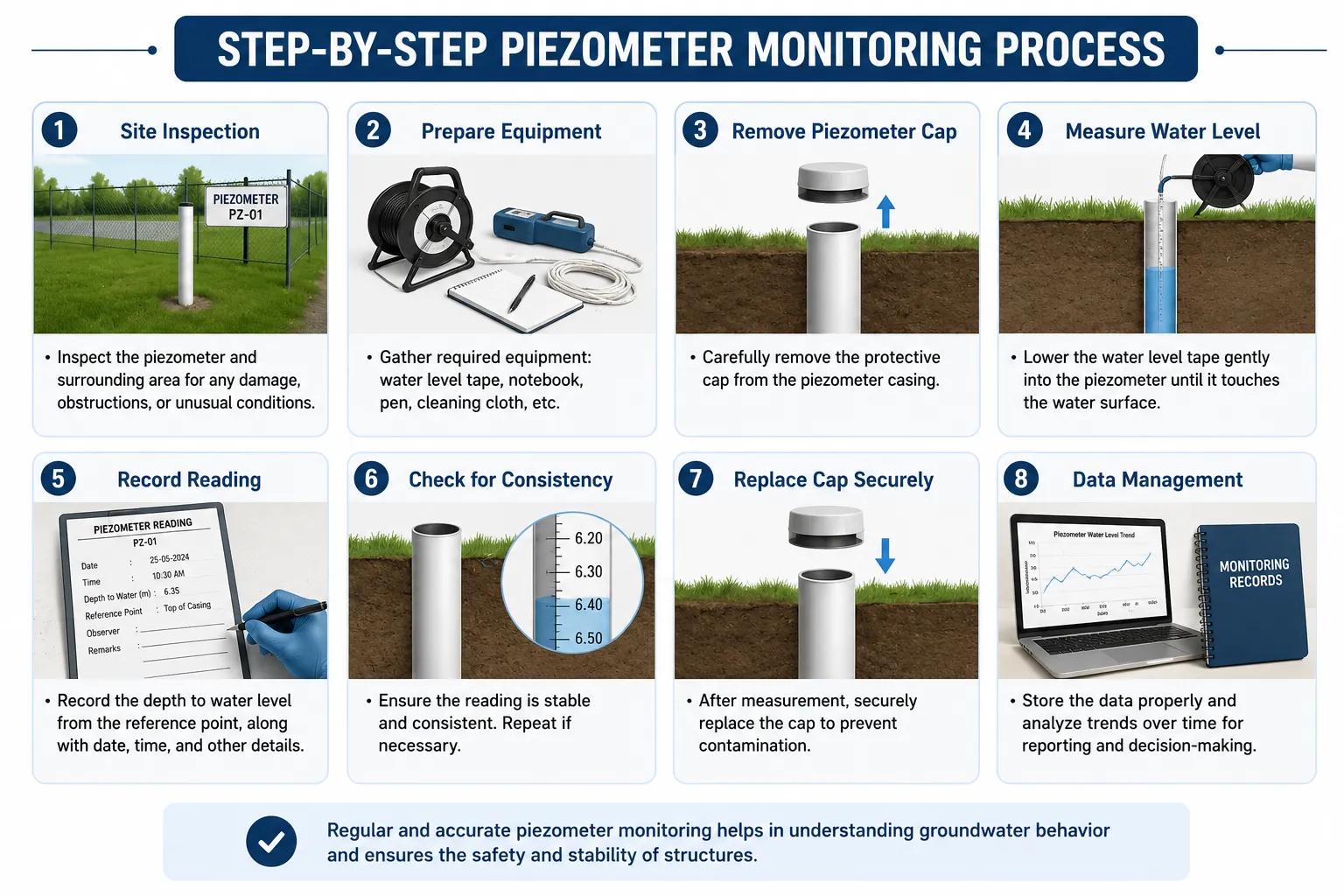
1. Site Inspection
A detailed review of the project site, geological conditions, and monitoring objectives is carried out to determine the optimum number, depth, and location of piezometers.
2. Borehole Drilling
Boreholes are drilled to the required depth using rotary, percussion, or auger drilling methods, depending on the subsurface profile and site access conditions.
3. Piezometer Installation
The selected piezometer — standpipe, vibrating wire, or pneumatic — is installed at the target depth with a sand filter pack around the porous tip and a bentonite or grout seal above to isolate the measurement zone.
4. Sensor Calibration
All sensors are calibrated prior to installation and verified in-situ to ensure measurement accuracy and data reliability throughout the monitoring period.
5. Groundwater Pressure Monitoring
Readings are collected at scheduled intervals — manually or automatically via data loggers — capturing groundwater pressure changes over time.
6. Data Collection & Transmission
Logged data is downloaded or transmitted remotely, compiled, and quality-checked before analysis.
7. Technical Analysis
Collected data is analysed to assess pore pressure trends, identify anomalies, and evaluate safety conditions against design thresholds.
8. Monitoring Report Preparation
A comprehensive technical report is prepared, summarising findings, trends, risk assessments, and engineering recommendations for the project team.
Factors Affecting Piezometer Readings
Accurate interpretation of piezometer data requires awareness of the following influencing factors:
- Groundwater Fluctuation: Seasonal recharge and discharge cycles cause natural variation in groundwater levels that must be separated from project-induced changes.
- Soil Permeability: Low-permeability soils (clays) exhibit slow pore pressure equilibration, meaning the piezometer reading may lag behind actual pressure changes.
- Rainfall and Recharge Events: Intense monsoon rainfall can cause rapid rises in piezometric levels, affecting stability assessments and requiring timely data review.
- Construction Activities: Earthworks, blasting, dewatering, and surcharge loading all generate pore pressure changes that must be distinguished from natural background conditions.
- Seepage Conditions: Localised zones of high permeability or preferential seepage pathways can produce unexpected pressure distributions within embankments or dam foundations.
Benefits of Professional Piezometer Monitoring Services
- Accurate Groundwater Monitoring: Scientific instrumentation delivers precise, reliable data free from observer error or equipment drift.
- Improved Infrastructure Safety: Real-time pore pressure data enables proactive management of dam, slope, and foundation safety.
- Better Geotechnical Analysis: High-quality piezometer data underpins robust numerical modelling and stability analysis.
- Early Risk Detection: Automated monitoring with threshold alerts provides early warning of developing pore pressure anomalies before they become safety incidents.
- Reliable Engineering Decisions: Data-driven insights reduce uncertainty in design, construction, and operational phases of geotechnical projects.
How Bhoojal Survey Can Help You
Bhoojal Survey is a trusted name in hydrogeological and geotechnical consultancy across India. With a dedicated team of qualified hydrogeologists, geotechnical engineers, and instrumentation specialists, we provide end-to-end piezometer monitoring solutions tailored to your project's specific requirements. Here is how we add value:
✔ Piezometer Installation
Services
We handle the complete installation process — site investigation, borehole drilling, piezometer placement, filter pack design, grouting, and surface protection — ensuring correct installation at every stage for reliable long-term performance.
✔ Groundwater Monitoring & Data Management
Our automated and manual monitoring services provide continuous or scheduled piezometric data collection, quality assurance, and cloud-based data storage — giving you access to live groundwater pressure trends at any time.
✔ Hydrogeological Investigation
Using SSRMPATS, GER DETECT, PQWT, and other advanced survey instruments, we carry out comprehensive hydrogeological investigations to map aquifer characteristics, groundwater potential zones, and subsurface geology for borewell siting and groundwater resource assessment.
✔ Dam Instrumentation &
Safety Monitoring
We design and implement full dam instrumentation packages — including vibrating wire piezometers, seepage measurement weirs, inclinometers, and settlement gauges — in compliance with CWC and BIS guidelines for dam safety monitoring in India.
✔ Geotechnical Instrumentation for Infrastructure
From railways and highways to tunnels, bridges, and industrial plants, our instrumentation team provides site-specific pore pressure monitoring systems that safeguard critical infrastructure throughout India.
✔ Technical Reporting & Engineering Recommendations
Every monitoring programme is supported by our detailed technical reports — featuring piezometric trend analysis, threshold assessments, risk evaluation, and clear engineering recommendations for project decision-makers and regulatory bodies.
✔ Pan-India Coverage
With the capability to mobilise experienced teams across all Indian states and union territories, Bhoojal Survey provides reliable, fast, and high-quality piezometer monitoring services for government, private, and industrial clients across India.
Why Choose Bhoojal Survey
- Experienced Team: Qualified hydrogeologists and geotechnical experts with extensive field experience across diverse Indian geological conditions.
- Advanced Instrumentation: Access to vibrating wire piezometers, automated data loggers, SSRMPATS, GER DETECT, PQWT, and comprehensive geophysical survey tools.
- Accurate Data Interpretation: Rigorous data QA/QC processes and expert analysis ensure monitoring results you can trust for critical safety decisions.
- Fast Reporting & Support: Rapid turnaround monitoring reports with clear findings and recommendations, supported by ongoing technical assistance.
- Pan-India Services: Operational experience across major dam projects, mining sites, railway corridors, highway projects, and urban groundwater monitoring programmes throughout India.
- Customised Solutions: Every monitoring programme is designed to meet your project's unique geological, engineering, and regulatory requirements.
- Regulatory Compliance: All work is carried out in accordance with CGWB guidelines, Ministry of Jal Shakti standards, BIS geotechnical codes, and CWC dam safety requirements.
Conclusion
A piezometer is used to measure the fundamental parameters that govern groundwater behaviour and geotechnical safety — pore water pressure, hydraulic head, seepage pressure, and water table levels. For any project involving dams, embankments, slopes, tunnels, mines, or infrastructure construction, accurate piezometer monitoring is not an option — it is an engineering necessity.
Bhoojal Survey brings together advanced instrumentation, deep technical expertise, and pan-India field capability to deliver piezometer monitoring programmes that protect lives, infrastructure, and investments. Whether you require a single observation well or a comprehensive real-time dam safety instrumentation system, our team is ready to support your project from initial site investigation to ongoing monitoring and reporting.
Contact Bhoojal Survey for professional piezometer installation and groundwater monitoring services across India. ■ Call Us | ■ Email Us | ■ Visit Our Website
Frequently Asked Questions (FAQs)
Q1. What is a piezometer used to measure?
A piezometer is used to measure groundwater pressure (piezometric head), pore water pressure, hydraulic head, seepage pressure, and water table levels in soil, rock, and fill materials. It is a fundamental instrument in geotechnical and hydrogeological monitoring.
Q2. Why are piezometers important in dam safety?
Piezometers embedded in a dam's core, foundation, and abutments continuously monitor pore water pressure. Elevated or rapidly rising pore pressures can indicate internal erosion, seepage pathways, or imminent stability failure — making piezometers a critical early warning tool in dam safety instrumentation programmes.
Q3. How does a vibrating wire piezometer work?
A vibrating wire piezometer uses a tensioned steel wire connected to a pressure-sensitive diaphragm. Groundwater pressure deflects the diaphragm, changing the tension and therefore the natural vibration frequency of the wire. An electromagnetic coil excites the wire and measures its frequency, which is electronically converted to a precise pressure reading.
Q4. What industries use piezometer monitoring in India?
Piezometer monitoring is used across dam and reservoir management, mining (open-cast and underground), railways and highways, tunnel construction, industrial foundations, building construction, environmental site investigation, and government groundwater management programmes throughout India.
Q5. How accurate are piezometer readings?
Modern vibrating wire piezometers offer an accuracy of ±0.1% of full-scale range, equivalent to approximately ±0.1 m of water head for a typical 100 m range instrument. Accuracy is maintained through proper installation, regular calibration, and quality data logging practices — all of which Bhoojal Survey implements as standard.
Q6. What is the difference between a standpipe and a vibrating wire piezometer?
A standpipe piezometer measures groundwater level directly by allowing water to rise within a tube — it is simple, robust, and low-cost but requires manual readings. A vibrating wire piezometer measures pore water pressure electronically at a sealed measurement point — it is suitable for automated remote monitoring, deep installations, and applications requiring continuous real-time data.
Q7. How long does a piezometer installation take?
A standard piezometer installation in a pre-drilled borehole typically takes one to two days, including borehole preparation, sensor installation, grout/bentonite sealing, and initial calibration. For large dam instrumentation or multi-instrument installations, the programme duration is planned based on site-specific requirements and access conditions.
Q8. Does Bhoojal Survey offer piezometer monitoring services across all Indian states?
Yes. Bhoojal Survey provides professional piezometer installation, monitoring, and groundwater analysis services across all Indian states and union territories — supporting government bodies, private developers, mining companies, infrastructure contractors, and industrial clients.