
Weak Borewell Discharge? Borewell Yield Testing Help
A borewell that delivers insufficient water is one of the most common and costly groundwater problems facing farmers, industries, and infrastructure developers across India. Low water yield, unpredictable discharge, and declining water levels during pumping are early warning signs that the borewell's productive capacity has not been properly evaluated. Borewell yield testing — also called a pumping test — is the scientific method used to accurately measure how much water a borewell can reliably supply.
Without a proper borewell yield test, project developers risk designing water supply systems around unreliable discharge estimates. This leads to pump failures, inadequate water availability during peak demand periods, and premature aquifer depletion. A professionally conducted groundwater pumping test provides the empirical data needed to design reliable, sustainable borewell-based water supply systems.
Bhoojal Survey provides professional borewell yield testing services across India — combining scientific pumping test methodology, advanced field instruments, and expert hydrogeological analysis to deliver accurate groundwater yield assessments for agricultural, industrial, and infrastructure projects.
What is Borewell Yield Testing?
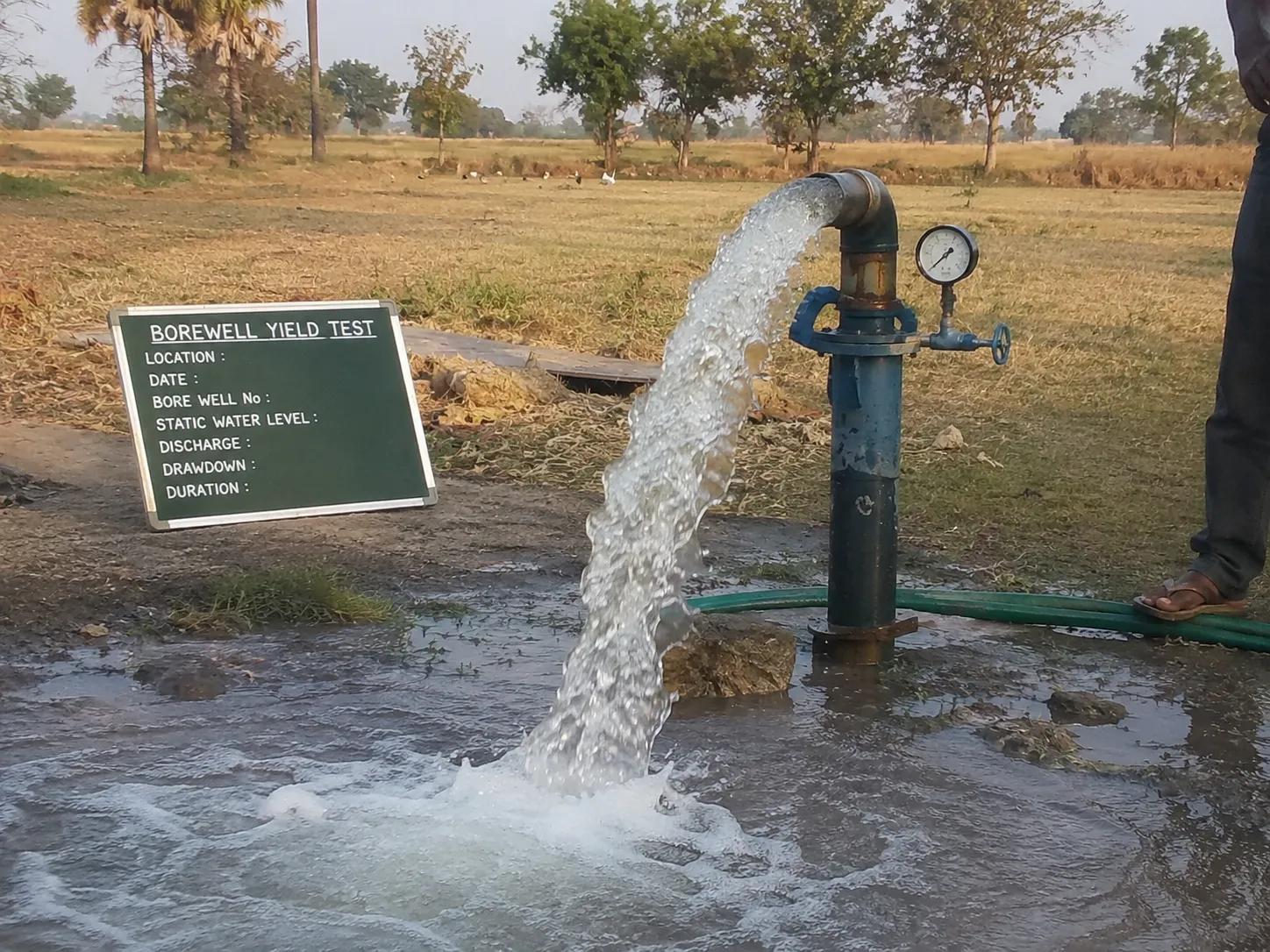
Borewell yield testing is a controlled field test in which water is pumped from a borewell at defined rates and the resulting changes in water level (drawdown) are measured over time. The test data is then analysed using established hydrogeological methods to determine the borewell's safe yield, aquifer hydraulic parameters, and long-term sustainable extraction capacity.
The primary objective of a borewell pumping test is to answer three fundamental questions: how much water can this borewell reliably produce, at what pumping rate will the water level stabilise without over-drafting the aquifer, and what is the aquifer's transmissivity and storativity — the parameters that govern long-term groundwater availability.
Key outputs of a professional borewell yield testing programme include:
- Safe sustainable yield — maximum reliable discharge rate (litres per hour or cubic metres perday)
- Specific capacity — discharge per unit drawdown, indicating borewell efficiency
- Aquifer transmissivity and hydraulic conductivity values
- Drawdown vs. time curves for pump design and operational planning
- Recovery rate — how quickly the water level recovers after pumping stops
- Recommended pump setting depth and motor capacity specifications
Why Borewell Yield Testing is Important
Many borewell projects in India proceed from drilling directly to pump installation without any scientific yield evaluation. This shortcut leads to pump oversizing, excessive drawdown, premature aquifer exhaustion, and ultimately borewell failure. A professional borewell discharge testing programme prevents all of these outcomes by establishing the borewell's true productive capacity before the water supply system is designed.
- Determining Groundwater Availability: Yield testing replaces guesswork with measured data — confirming exactly how much groundwater the borewell can deliver on a sustained basis for your project's daily and seasonal demand.
- Reducing Borewell Failure Risk: Pumping a borewell beyond its safe yield causes excessive drawdown, air entrainment, pump damage, and eventually permanent aquifer dewatering. Yield testing defines the safe operational limits that prevent these failures.
- Sustainable Groundwater Extraction Planning: Sustainable yield testing identifies the extraction rate that keeps the borewell productive for years or decades — critical for agricultural irrigation, industrial supply, and municipal water systems.
- Industrial and Agricultural Water Management: Industries requiring consistent groundwater supply for manufacturing processes, cooling systems, or irrigation networks depend on accurate aquifer yield analysis to plan storage, treatment, and distribution infrastructure correctly.
- Improving Borewell Performance Evaluation: Step drawdown tests reveal borewell efficiency and identify whether low yield is caused by aquifer limitations, borewell design deficiencies, or pump selection errors — guiding targeted remediation decisions.
Methods Used in Borewell Yield Testing
Bhoojal Survey conducts borewell yield testing using internationally recognised hydrogeological field test procedures combined with advanced groundwater and hydrogeological testing solutions. Our team of experienced hydrogeologists designs each testing programme to match the borewell's construction, aquifer type, and project requirements.
- Step Drawdown Test:
The borewell is pumped at three to five progressively increasing discharge rates, each maintained for a fixed duration (typically 60–120 minutes per step). Water level drawdown at each step is recorded. The data is analysed to determine borewell efficiency, well loss coefficients, and the optimum sustainable pumping rate — identifying the discharge beyond which excessive turbulent losses reduce borewell productivity.
- Constant Rate Pumping Test:
The borewell is pumped at a single constant discharge rate for an extended period — typically 6, 12, or 24 hours depending on aquifer type and project requirements. Continuous water level drawdown data is recorded at the pumped borewell and, where available, at observation wells. Theis, Cooper-Jacob, or other standard analytical methods are applied to calculate aquifer transmissivity and storativity.
- Groundwater Discharge Measurement:
Discharge is measured using calibrated flow meters, V-notch weirs, or orifice plates. Accurate discharge measurement is fundamental to yield test validity — errors in discharge recording directly compromise aquifer parameter calculations and safe yield estimates.
- Aquifer Performance Analysis:
Field data is processed using hydrogeological software to generate time-drawdown and distance-drawdown plots. These are interpreted by experienced hydrogeologists to determine aquifer parameters, assess borewell efficiency, and produce design-ready yield recommendations.
- Recovery Test and Yield Interpretation:
After pumping stops, the rate at which the water level recovers is monitored and recorded. Recovery data provides an independent estimate of aquifer transmissivity and confirms the reliability of pumping phase analysis. Together, the pumping and recovery datasets support confident sustainable yield determination.
Bhoojal Survey conducts hydrogeological survey using SSRMPATS Instrument, GER DETECT, and PQWT at site for open well / borewell location — delivering advanced groundwater and hydrogeological testing solutions with scientific groundwater investigation and yield analysis.
Applications of Borewell Yield Testing Services
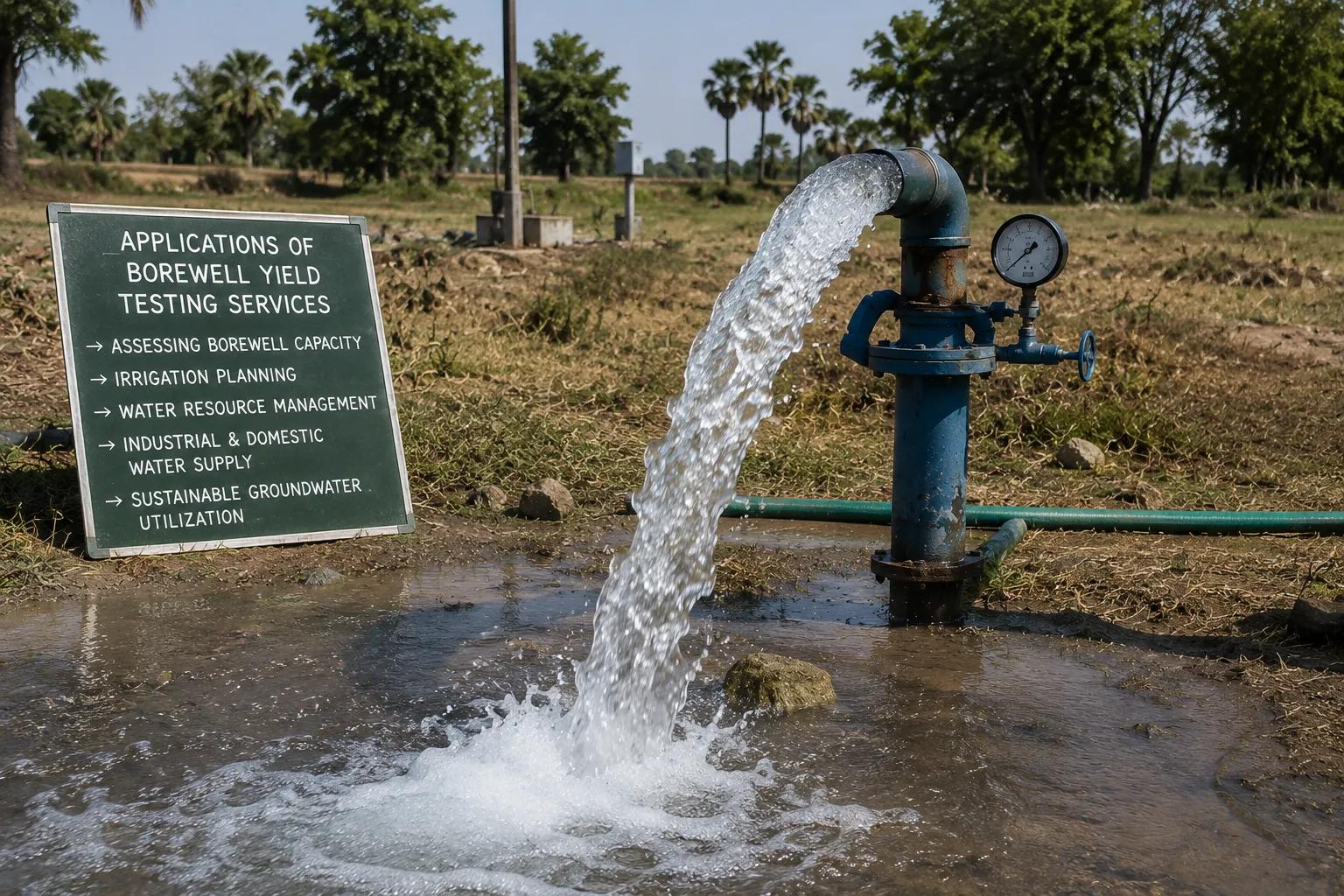
Professional borewell yield testing is required wherever groundwater is a critical input to project operations. Bhoojal Survey has delivered aquifer yield assessment consultancy for the following application sectors across India:
• Agricultural Irrigation Borewells
• Government Groundwater Resource Planning
• Industrial Groundwater Supply Systems
• Borewell Recharge & Sustainability Studies
• Infrastructure & Mining Projects
• Municipal Water Supply Schemes
• Commercial Water Management Systems
• CGWA NOC Groundwater Compliance Support
For each application, Bhoojal Survey delivers a comprehensive borewell performance testing report including field test data, drawdown analysis, aquifer parameter calculations, safe yield recommendations, and pump design specifications — all prepared to professional hydrogeological reporting standards.
Why Choose Bhoojal Survey for Borewell Yield Testing Services
Bhoojal Survey is a trusted professional groundwater testing consultancy providing borewell yield testing, pumping test analysis, and aquifer performance assessment services across India. Our experienced team combines rigorous field methodology with expert hydrogeological interpretation to deliver yield test results you can rely on.
- Experienced Hydrogeologists & Groundwater Experts: Our team has conducted borewell pumping tests across diverse Indian aquifer types — from hard rock basalt and granite formations to alluvial sand-gravel aquifers in river valleys — and brings deep practical expertise to every yield testing assignment.
- Advanced Pumping Test Technologies: We deploy precision data loggers, calibrated pressure transducers, and accurate discharge measurement equipment to capture high-quality field data that supports reliable aquifer analysis.
- Accurate Aquifer Yield Analysis: Every yield test is processed and interpreted by qualified hydrogeologists using standard analytical methods, delivering scientifically validated safe yield and aquifer parameter results.
- Fast Reporting & Technical Consultancy: Borewell yield test reports are prepared promptly after field operations, including complete data tables, drawdown plots, aquifer parameter analysis, and practical pump design recommendations.
Conclusion
A borewell without a proper yield test is a water supply system built on assumption. Borewell yield testing replaces uncertainty with measured, scientifically validated groundwater data — giving you the confidence to invest in the right pump, design the right water storage system, and plan around a reliable daily yield figure rather than a hopeful estimate.
Whether you are a farmer planning an irrigation borewell in hard rock terrain, an industrial developer designing a manufacturing water supply system, or a project engineer preparing a CGWA NOC application, Bhoojal Survey's professional pumping test and groundwater yield assessment services deliver the technical foundation your project needs.
Contact Bhoojal Survey for professional borewell yield testing and groundwater pumping test services across India.
Frequently Asked Questions (FAQ)
1. What is borewell yield testing and why is it important?
Borewell yield testing is a scientific field procedure in which a borewell is pumped at controlled discharge rates and the resulting water level changes are measured and analysed. It determines the borewell's safe sustainable yield, aquifer hydraulic parameters, and long-term groundwater availability. It is important because designing a water supply system without yield test data risks pump failure, borewell exhaustion, and inadequate water supply — particularly in hard rock aquifer regions of India.
2. What is a step drawdown test and what does it measure?
A step drawdown test pumps the borewell at three to five progressively increasing discharge rates, each held constant for a set duration. Water level drawdown is recorded at each step. The test measures borewell efficiency, identifies the rate at which turbulent well losses become excessive, and determines the optimum sustainable pumping rate. It is typically performed before a constant rate pumping test as the first stage of a comprehensive borewell yield testing programme.
3. How is borewell discharge accurately measured during a yield test?
Borewell discharge is measured using calibrated field instruments including electromagnetic flow meters, mechanical turbine meters, V-notch weir tanks, or orifice plates, depending on the discharge volume and site conditions. Accurate, stable discharge measurement is essential to yield test validity — any variation in pumping rate during a constant rate test directly affects drawdown data quality and aquifer parameter calculations.
4. How long does a borewell pumping test take?
A standard borewell yield testing programme typically takes one to two field days. A step drawdown test requires 4–10 hours depending on the number of steps. A constant rate pumping test for most agricultural or small industrial borewells runs 6–12 hours, followed by a recovery monitoring period of equal duration. Deep aquifer tests for large industrial projects may require 24–72 hour constant rate tests. Bhoojal Survey designs test duration based on aquifer type, borewell depth, and project requirements.
5. Why do borewells fail when pumped without a prior yield test?
Borewells pumped without yield testing are routinely oversized — fitted with pumps that extract water faster than the aquifer can recharge the borewell. This causes excessive drawdown, the pump running dry, air entrainment and pump damage, and permanent dewatering of the productive fracture zones or aquifer layers. Over time, over-pumping also reduces specific capacity and permanently impairs the borewell's long-term productivity. A borewell yield test prevents all of these outcomes by defining the safe extraction rate before pump installation.