
Accurate water flow measurement is no longer optional in modern industry. Whether you are managing a water treatment plant in Maharashtra, running a solar park cooling system in Rajasthan, or overseeing a large EPC project at an industrial estate, knowing exactly how much liquid is moving through your pipelines at any given moment can directly affect your operational efficiency, safety compliance, and bottom line.
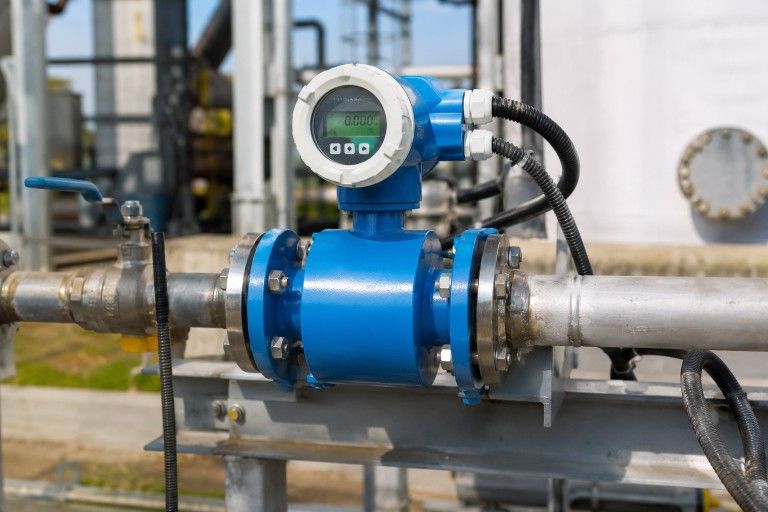
A Digital Flow Meter is the precision instrument that makes this real-time flow monitoring possible. Unlike traditional mechanical meters that wear out and lose accuracy over time, digital flow meters use advanced sensing technologies such as electromagnetic and ultrasonic principles to deliver consistent, high-accuracy readings with minimal maintenance requirements. They are compact, smart, and increasingly integrated into industrial automation and utility management platforms across India.
At Bhoojal Survey, we integrate digital flow meter installation, calibration, and monitoring as part of our broader hydrogeological and infrastructure testing services for industrial, government, mining, telecom, and construction clients nationwide. This guide covers everything you need to know about digital flow meters and how professional deployment can improve your water management system.
What is a Digital Flow Meter?
A Digital Flow Meter is an electronic instrument designed to measure the volumetric or mass flow rate of a liquid or gas moving through a pipe. It captures real-time flow data and displays it on a digital readout or transmits it directly to a control panel, SCADA system, or industrial automation platform.
The core function of any flow meter is to quantify pipe flow measurement: how many litres per second, cubic metres per hour, or gallons per minute are passing through a defined cross-section. Digital variants replace the mechanical impellers and analog dials of older meters with electronic sensors, signal processors, and digital outputs. This transition dramatically improves both measurement accuracy and data reliability.
Modern digital flow meters are built around several core technologies including electromagnetic induction, ultrasonic transit-time measurement, vortex shedding principles, and turbine rotation sensing. Each technology has specific advantages depending on the liquid type, pipe diameter, flow velocity, and installation environment. Professional selection is critical to achieving high precision flow meter performance in field conditions.
In the context of industrial water management, a digital measurement device of this nature provides not just instantaneous readings but also cumulative flow totals, flow alarms, and data logs that support proactive decision-making across large infrastructure networks.
Why Digital Flow Meters Are Important in Industrial Projects
In any industrial process involving water or liquid, what you cannot measure you cannot control. Digital flow meters provide the measurement backbone for an entire range of operational and safety functions:
- Accurate flow monitoring eliminates guesswork in water consumption, enabling precise billing and resource planning.
- Leak detection becomes straightforward when real-time flow data reveals unexplained variations between input and output readings.
- Energy efficiency improves significantly when pump systems operate based on actual demand data rather than fixed schedules.
- Equipment protection is enhanced by monitoring flow rates that fall outside safe operating windows, triggering automatic shutdowns before damage occurs.
- Reduced operational costs result from eliminated losses, lower water wastage, and optimised chemical dosing in treatment processes.
- Long-term system reliability is supported through historical flow data that informs maintenance schedules and infrastructure planning.
- Regulatory compliance is simplified when accurate, auditable flow records are available for pollution boards, utility authorities, and ISO certification bodies.
For EPC contractors, industrial project owners, and government infrastructure agencies in India, deploying a reliable flow monitoring system is increasingly a contractual and regulatory requirement rather than a choice.
Applications of Digital Flow Meters Across Industries
The versatility of digital flow measurement technology means it is deployed across virtually every sector that uses liquids in any meaningful volume:
- Water Treatment Plants: Monitoring raw water intake, treated water output, and distribution flow to ensure process efficiency and regulatory compliance.
- Industrial Manufacturing Units: Controlling cooling water, process water, and chemical feed lines with high-accuracy liquid flow monitoring.
- Oil and Gas Industry: Measuring crude, refined products, and associated water streams throughout upstream and downstream operations.
- Chemical Processing Plants: Managing aggressive or high-viscosity liquids in reactors, mixers, and transfer systems where precise dosing is critical.
- HVAC Systems: Monitoring chilled water and heating water loops in commercial buildings, data centers, and hospitals.
- Irrigation Systems: Enabling water audit and allocation for large-scale agricultural and horticulture projects.
- Commercial Buildings and SEZs: Sub-metering water consumption for individual zones, floors, or tenants as part of smart building infrastructure.
- Food and Beverage Industry: Measuring water and ingredient flow lines with sanitary-grade meters approved for food contact applications.
- Pharmaceutical Facilities: Monitoring purified water and WFI (Water for Injection) systems with validated, high-precision instruments.
- Fire Protection Systems: Verifying sprinkler and hydrant line flows during commissioning and periodic testing.
- Municipal Water Supply Projects: Large-diameter ultrasonic meters installed across distribution mains to detect non-revenue water losses.
- Power Plants and Solar Projects: Monitoring cooling tower makeup water, condenser circuits, and panel-cleaning water systems.
Types of Digital Flow Meters
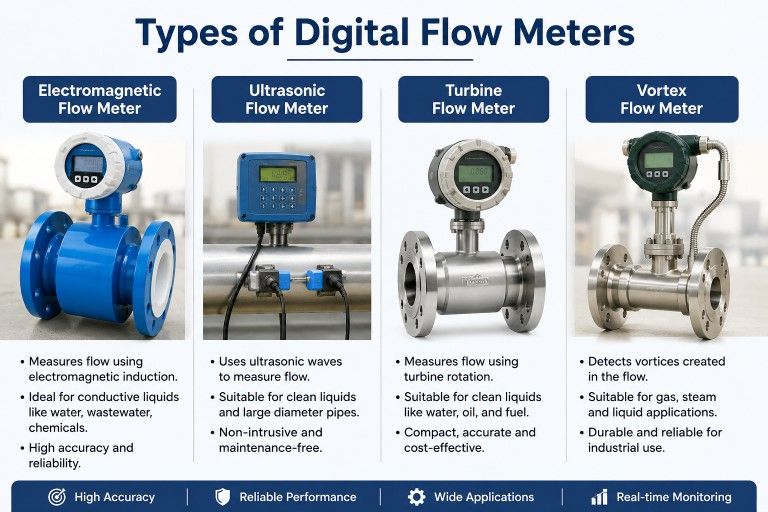
Selecting the correct type of digital flow meter is a technical decision that depends on the application, liquid characteristics, and accuracy requirements. Bhoojal Survey's engineering team evaluates all these factors before recommending a specific technology:
Electromagnetic Flow Meter (Magmeter)
Electromagnetic flow meters operate on Faraday's Law of electromagnetic induction. When a conductive liquid flows through a magnetic field generated by the meter's coils, a voltage is induced proportional to the flow velocity. This voltage is measured and converted to flow rate.
Electromagnetic technology is the industry standard for water, wastewater, slurries, and most conductive liquids. It has no moving parts, creates zero pressure drop, and delivers accuracy levels of ±0.5% or better. It is the preferred choice for water treatment plants, municipal supply lines, and industrial effluent monitoring. However, it requires the liquid to be electrically conductive, meaning it cannot be used for petroleum products or pure gases.
Ultrasonic Flow Meter
Ultrasonic flow meters measure flow by transmitting high-frequency sound pulses through the liquid and calculating flow rate from the difference in transit time between upstream and downstream signals. Clamp-on variants attach to the outside of existing pipes without any cutting or process interruption, making them ideal for retrofit installations on live lines.
Ultrasonic flow technology works on both conductive and non-conductive liquids including oils, chemicals, and gases. It is particularly valuable in large-diameter pipes at water treatment plants, power plants, and municipal distribution networks where installation of inline meters is impractical.
Turbine Flow Meter
Turbine flow meters use a rotor placed in the liquid stream. As liquid flows through, the rotor spins at a speed proportional to the flow velocity. Electronic sensors count rotor rotations and calculate flow rate. They offer high accuracy for clean, low-viscosity liquids and are widely used in petroleum product measurement, chemical dosing lines, and water injection systems. They require regular maintenance due to moving parts and are not suitable for slurries or abrasive liquids.
Vortex Flow Meter
Vortex flow meters detect vortices shed by a bluff body placed in the flow stream. The frequency of vortex shedding is proportional to the flow velocity. They are robust, have no moving parts, and perform well in steam, hot water, gases, and many industrial liquids. They are commonly found in power generation, process industries, and HVAC applications. Vortex meters handle high-temperature and high-pressure conditions that can challenge other technologies.
Equipment and Instruments Used in Digital Flow Measurement
A complete digital flow monitoring setup involves more than just the primary meter. Bhoojal Survey deploys an integrated suite of advanced flow monitoring and industrial measurement solutions for water, liquid, and utility management applications, including:
- Primary digital flow meter (electromagnetic, ultrasonic, turbine, or vortex as specified)
- Flow sensors and transducers for signal generation and capture
- Signal transmitters and converters for 4-20mA or HART output
- Control panels and PLC integration modules
- Data logging systems with onboard memory and USB/Ethernet export
- Wireless monitoring systems with GSM/GPRS or Wi-Fi telemetry
- Calibration instruments including reference meters and dry calibrators
- Industrial pipeline monitoring equipment including pressure and temperature sensors
- SCADA-compatible data outputs for smart industrial automation solutions
This integrated approach supports scientific flow measurement and monitoring systems that deliver not just readings but actionable operational intelligence. All instruments are sourced from certified manufacturers and calibrated against traceable standards before deployment.
Factors Affecting Digital Flow Meter Accuracy
Even the most advanced flow monitoring system can underperform if key installation and operational factors are not properly managed. Bhoojal Survey's field engineers are trained to identify and mitigate the following common accuracy challenges:
- Flow Velocity: Each meter technology has a defined minimum and maximum velocity range. Operation outside this range reduces accuracy and may damage the instrument.
- Pipe Diameter: Meter sizing must match the pipe's internal bore precisely. Undersized or oversized meters introduce systematic measurement errors.
- Liquid Viscosity: High-viscosity liquids alter the velocity profile inside the pipe, affecting electromagnetic and turbine meter readings. Compensation algorithms or specific meter types are required.
- Temperature and Pressure Variations: Significant fluctuations change liquid density and viscosity, directly affecting calculated mass flow values. Temperature-compensated meters are essential in process applications.
- Air Bubbles and Entrained Gas: Air pockets disrupt the continuous liquid column required for accurate electromagnetic measurement and can cause turbine rotors to overspeed.
- Installation Conditions: Insufficient straight pipe runs upstream and downstream of the meter create turbulent flow profiles that distort readings. Industry standards typically require 10-20 pipe diameters of straight run.
- Pipe Material and Alignment: Magnetic or electrically conductive pipe materials can interfere with electromagnetic meters. Misaligned flanges create flow disturbances that reduce accuracy.
Step-by-Step Digital Flow Meter Installation Process
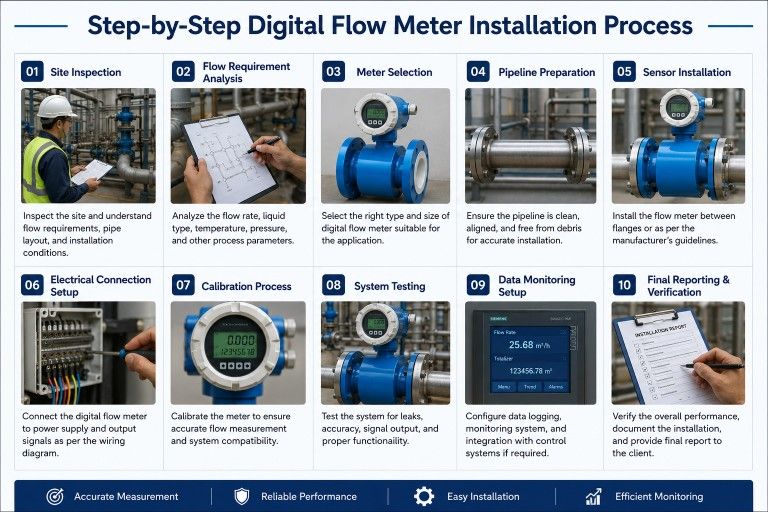
Bhoojal Survey follows a structured, standards-based installation methodology for every digital flow meter deployment, ensuring reliable performance from day one:
- Site Inspection: Our engineers conduct a physical survey of the installation location, assessing pipe routing, access conditions, electrical supply availability, and safety requirements.
- Flow Requirement Analysis: We review the client's flow range, liquid characteristics, required accuracy class, and data output needs to define the performance specification.
- Meter Selection: Based on analysis findings, we select the optimal technology type, model, and size from approved product lists, ensuring compatibility with the process and regulatory requirements.
- Pipeline Preparation: We confirm adequate straight pipe runs, mark and prepare the installation point, and arrange for line isolation, draining, and any necessary hot-tap or weld-in provisions.
- Sensor and Body Installation: The meter body or sensor assembly is installed in accordance with the manufacturer's instructions and applicable standards, with correct orientation and grounding.
- Electrical Connection Setup: Signal cables, power supplies, and output connections are installed to the transmitter and any connected control systems, following safe wiring practices and IP protection requirements.
- Calibration Process: The installed meter is configured with correct pipe dimensions, liquid parameters, and output settings, and verified against known reference flows where site conditions permit.
- System Testing: We perform a full functional test including zero-flow verification, simulated high-flow checks, alarm threshold testing, and data output verification.
- Data Monitoring Setup: We configure data loggers, SCADA connections, or remote monitoring portals as required, and verify correct data transmission and storage.
- Final Reporting: We issue a detailed commissioning report including installation photographs, calibration certificates, test results, and operating instructions for the client's records.
Benefits of Professional Digital Flow Meter Services
Investing in professionally installed and calibrated digital flow meters delivers tangible operational and financial returns:
- Accurate measurement eliminates estimation errors in water billing, process control, and resource planning.
- Reduced water and liquid losses through early leak detection and continuous consumption monitoring.
- Improved industrial efficiency through data-driven pump scheduling, chemical dosing, and process optimisation.
- Direct cost savings from lower water consumption, reduced energy use, and elimination of manual meter reading.
- Better process automation through integration of flow data into PLC and SCADA systems.
- Reliable monitoring with minimal maintenance requirements due to solid-state, no-moving-parts sensor technology.
- Preventive maintenance support through trend analysis that identifies degrading performance before failures occur.
- Long-term operational performance backed by manufacturer warranties and Bhoojal Survey's ongoing calibration and technical support services.
How Bhoojal Survey Helps You with Digital Flow Meter Services
Bhoojal Survey is not just an equipment supplier. We are a full-service technical consultancy with deep expertise in water management, hydrogeological surveying, and industrial infrastructure testing. Here is how we specifically help our clients at every stage of a digital flow meter project:
End-to-End Technical Consultation
From the first inquiry to final commissioning, our engineering team provides detailed technical advice on meter selection, installation planning, and system integration. We assess your specific liquid properties, pipe conditions, and data requirements to recommend the exact solution your project needs, saving you from costly specification errors.
Site Survey and Feasibility Assessment
Before any installation, Bhoojal Survey conducts a thorough on-site inspection and flow requirement survey. This is part of our standard scientific methodology, the same rigorous field approach we apply to groundwater surveys and geophysical investigations. We identify installation challenges early and design solutions that meet industry standards.
Procurement and Supply of Certified Instruments
We source digital flow meters and associated instrumentation from certified manufacturers meeting IS, ISO, and international standards. As a professional service provider and supplier in India, we handle procurement, quality verification, and logistics so that only tested, calibrated instruments reach your site.
Professional Installation Services
Our trained field engineers carry out all mechanical and electrical installation work in compliance with applicable codes and manufacturer specifications. Whether it is a single inline meter at a water treatment plant or a network of ultrasonic meters across a large industrial campus, we deploy with precision and professionalism.
Calibration Services and Performance Verification
Post-installation calibration is non-negotiable. We calibrate every meter against traceable reference standards and issue formal calibration certificates. Our calibration services are available on an annual or as-required basis to maintain ongoing measurement accuracy and support quality management systems.
Integration with Existing Industrial Automation Systems
Bhoojal Survey has experience integrating digital flow meters into SCADA platforms, building management systems, and industrial IoT networks. If you already have an automation infrastructure, we connect your new meters seamlessly into it. If you are starting fresh, we can design and implement a complete smart industrial automation solution around your flow monitoring needs.
Maintenance, Repair, and Technical Support
We provide ongoing maintenance services, troubleshooting support, and repair services for all systems we install. Our technical support team is available for rapid response to performance issues, helping you maintain continuous flow monitoring without operational disruption. We offer both scheduled maintenance contracts and on-call support arrangements.
Documentation and Regulatory Reporting
Every Bhoojal Survey project concludes with complete technical documentation including installation reports, calibration certificates, as-built drawings, and operating manuals. This documentation package supports your regulatory submissions, ISO audits, and internal quality records.
Whether you are an EPC contractor managing a power substation project in Uttar Pradesh, a mining company monitoring process water in Jharkhand, or a government agency upgrading municipal water supply metering in Tamil Nadu, Bhoojal Survey delivers expert industrial solutions tailored to your specific requirements. Get a quote today and speak with our technical team about your flow monitoring requirements.
Why Choose Bhoojal Survey for Digital Flow Meter Projects
Bhoojal Survey has built its reputation on delivering technically rigorous, field-proven measurement and survey services across some of India's most demanding infrastructure environments. When you choose us for your digital flow meter requirements, you gain:
- An experienced technical team with multi-disciplinary expertise spanning hydrogeology, geophysics, electrical engineering, and industrial instrumentation.
- Access to advanced digital monitoring instruments from certified manufacturers, supplied with full documentation and warranty coverage.
- Professional installation and calibration services following IS and international standards, with formal commissioning reports.
- Fast technical support with structured response commitments and a pan-India service network.
- Pan-India service support covering major industrial hubs, infrastructure corridors, government project sites, and remote locations.
- Customised industrial solutions designed around your specific application, liquid type, process environment, and budget.
- Water management and industrial expertise drawn from years of hands-on field work across hundreds of infrastructure projects.
- Scientific testing and monitoring methodology that ensures measurement integrity and supports regulatory compliance.
We invite you to contact us, book a survey, or request a detailed project consultation. Our team is ready to assess your flow monitoring requirements and deliver a solution that performs reliably throughout your project lifecycle.
Conclusion
Digital flow meters have become indispensable instruments in modern Indian industry. From municipal water authorities trying to eliminate non-revenue water to solar plant operators managing cooling systems to pharmaceutical manufacturers maintaining validated water systems, accurate, real-time flow measurement is a foundation of operational excellence.
The technology has advanced significantly. Today's digital flow meters are smarter, more accurate, easier to integrate, and more durable than ever before. But the difference between a meter that performs and one that fails often comes down to specification, installation quality, and calibration rigour, all areas where professional expertise makes a measurable difference.
Bhoojal Survey brings that expertise together with our broader capabilities in hydrogeological survey, geophysical investigation, and infrastructure testing to provide complete, reliable industrial solutions for our clients across India. We do not just supply instruments. We deliver measurement confidence.
Ready to upgrade your flow monitoring system? Contact Bhoojal Survey today for a no-obligation technical consultation. Our team is available to discuss your project, conduct a site assessment, and provide a competitive quotation for complete digital flow meter installation, calibration, and monitoring services.
Frequently Asked Questions (FAQs)
Q1. What is a digital flow meter?
A digital flow meter is an electronic instrument that measures the flow rate and total volume of liquid or gas moving through a pipe. It uses technologies such as electromagnetic induction, ultrasound, or vortex sensing to generate accurate, real-time flow data displayed digitally or transmitted to a control or monitoring system.
Q2. How does a digital flow meter work?
The working principle depends on the type. Electromagnetic meters measure voltage induced by conductive liquid flowing through a magnetic field. Ultrasonic meters calculate flow from the difference in sound transit times. Turbine meters count rotor revolutions. Vortex meters detect flow-induced pressure oscillations. All types convert the measured signal into a digital flow rate reading.
Q3. Which industries use digital flow meters in India?
Digital flow meters are used across water treatment, oil and gas, pharmaceuticals, food and beverage, chemical processing, mining, power generation, solar plants, HVAC, fire protection, municipal water supply, and industrial manufacturing. Any industry involving controlled liquid flow is a potential user.
Q4. What is the most accurate type of digital flow meter?
Electromagnetic flow meters are generally considered the most accurate for conductive liquids like water, achieving ±0.5% or better under ideal conditions. For custody transfer of refined petroleum products, Coriolis meters offer the highest accuracy. The best choice depends on the specific application, liquid type, and accuracy requirements.
Q5. Why is flow measurement important in industrial projects?
Accurate flow measurement enables process control, resource conservation, leak detection, energy optimisation, regulatory compliance, and equipment protection. Without reliable flow data, industrial processes cannot be controlled efficiently, water losses cannot be identified, and billing and resource allocation cannot be done accurately.
Q6. How often should a digital flow meter be calibrated?
Most standards and manufacturers recommend annual calibration for flow meters used in billing, regulatory reporting, or critical process control. Meters in lower-stakes applications may be calibrated every two years. After any significant process change, physical disturbance, or apparent measurement drift, recalibration should be performed promptly.
Q7. Can digital flow meters measure water accurately in large pipes?
Yes. Ultrasonic clamp-on meters are specifically designed for large-diameter pipes and can measure water flow accurately in mains ranging from 100mm to over 2000mm without any pipe cutting. Electromagnetic meters are available in large sizes for installation in water treatment and distribution infrastructure.
Q8. What factors affect the accuracy of a digital flow meter?
Key factors include pipe diameter and material, liquid viscosity and conductivity, flow velocity profile, temperature, pressure, presence of air bubbles, installation location (straight pipe runs), and environmental conditions such as vibration and electromagnetic interference. Professional installation and site assessment significantly reduces the impact of these factors.